Too many biases

“50 cognitive biases to be aware of so you can be the very best version of you” reads an infographic at The Visual Capitalist. If biases are systematic ways our actual thinking diverges from rational thinking, then doesn’t the fact that there are fifty of them just possibly hint that the systematic error lies in how we define rationality? For several years, I had been orbiting Kahneman’s Thinking Fast and Slow and I finally descended to the surface. Even though I’ve ingested a lot of its content second-hand over the decade+ since its publication, there are many fascinating insights and examples that make it a worthwhile read. Still, I keep coming back to a very basic question: Is our model of rational decision-making under uncertainty the problem, and not our purported biases? Is behavioral economics’ long catalog of biases analogous to the epicycles introduced to defend the geocentric worldview?

Example: Kahneman’s subchapter on the “Entrepreneurial Delusion” in which small business owners estimate the chances of any comparable company’s success at around 60% whereas the five-year survival rate of small businesses in the US is around 35%. On the face of it, that might make starting up a business look delusional. Kahneman chalks this one up to optimism bias, also one of the fifty in the infographic. The 60% stat comes from this study in which entrepreneurs were asked something about the “odds of success.” To Kahneman, these are meaningfully comparable numbers: He explicitly says that 60% was “almost double the true value” [my italics]. However, a lot of the difference between 60% and 35% might be explained not by a delusion, but by how entrepreneurs define “success” differently from a five-year survival rate.

Five years is a fairly long time, during which a company may have changed its product, its customer base, its business model, its staff, its ownership structure, and its public-facing name, and yet still continue under its original articles of incorporation. Any one of those changes alone might have merited shuttering the original business and a new incorporation. Was it then a success or a failure? Referring to another paper in the notes of the book, Kahneman writes that “[e]ntrepreneurs who have failed are sustained in their confidence by the probably mistaken belief that they have learned a great deal from the experience.” Why should that belief be mistaken, and why shouldn’t an experiment that rules out a certain path be counted as a success? Kahneman’s comparison of the 60% figure to the 35% figure is an apples-to-oranges situation that does not justify labeling entrepreneurs as “delusional.”

What’s more, if an entrepreneur believed that the success rate – however defined – of a company in her space was 60%, and if there were good reasons to believe that, then many entrepreneurs would attempt to enter that space. But the number of competitors in the space is a major contributing factor to the eventual success rate. The actual success rate is a function of what people believe it to be. In what sense can you even speak of a “true value” until after the startup decision has been made?

The error seems to me to be to apply the same logic you do to a roulette table – with its known outcomes, known probabilities, and independent observations – to a startup, particularly at the small business level where entrepreneurs may be pursuing a range of goals. The people I have known who have embraced an uncertain future, whether as artists or entrepreneurs, have generally not approached their projects as they would casino games. “The world would be a cooler place if my idea worked,” they say. “My life as a whole will be less successful if I do not try this.” They consider what “success” will look like, and if it’s attractive to them. They consider what “failure” would look like and whether it is bearable. They choose endeavors where “heads” means they win in one way, and “tails” means they win in another. Is this delusional and biased? Or is the real delusion to apply casino logic to this life choice?

In any event, if being my best self means maintaining fifty things in awareness, then I’m just going to have to surrender to my “irrationality.”

Орёл I win, решка you lose

Two running threads in my professional life have been the questions “What is strategy?” and “How do leaders make decisions?” These questions reverberate only distantly through the Ruminathans’ main topics. But the invasion of Ukraine has brought them to the top of my mind in ways that are harder to explore on-the-job. So, a Ruminathan it is!

Partly to distract myself from the harsh humanitarian reality and the worry that this could all get much, much worse, my mind has been drawn to the basic puzzle: What was Putin thinking? Why attack a nation of 43 million with an army of just 150,000? In the muddy season? With conscripts?

There are any number of commentators, with and without military experience, who are happy to raise these questions and characterize Putin’s decision as a miscalculation. Putin, hoping for a quick win and the installation of a Kremlin-friendly regime, underestimated Ukrainian resolve and resourcefulness, Western willingness to support rhetorically and logistically, and his own generals’ incompetence. By day, I teach about how leadership teams stumble into (and ideally find their way back out of) information bubbles that impair their decision-making capabilities. It’s possible that Putin is stuck in such a bubble as wiser heads than mine have suggested.

There is certainly attraction to the adage that you shouldn’t attribute to malice what can be explained by incompetence. But I have a hard time believing that Putin and his inner circle placed all the chips on “fast victory” without considering “quagmire” as a possible outcome. Instead, I suspect that, like any smart operator, Putin considered both possibilities, and saw that this was a “heads I win / tails you lose” situation. He may well have chosen to invade based on a decision tree that favored “fast victory” both because he preferred that outcome and because he judged it more likely. But I doubt he would have rolled the dice without seeing “quagmire,” including sanctions and isolation, as an acceptable outcome.

How does he benefit from what may well be a long, bloody stalemate? It all depends on your goals and how you can achieve them when they conflict with others’. In a word, “strategy.”

I’ll take for granted for now that the goal of an autocrat is to remain in power. I’ve resisted that belief for a long time because I have always believed, and still do, that “power” is a meaningless concept unless it is the “power to” do something. Power shouldn’t be a goal in and of itself. The reason I’m willing to entertain the possibility that power can be seen as a goal in and of itself is that I am now firmly in life’s second half. And I can already tell that the next decades, if I am lucky enough to have them, will be a constant rear-guard action to hold onto power over my own body and mind. Yes, there ought to be (and for me, is) a purpose to that battle. But it’s not hard to envision that it will eventually become difficult to distinguish ends from means. Certainly, better men and women than I have failed to do so. So especially for a (near) 70-year-old autocrat, it’s probably reasonable to assume that “staying in power” is the goal, end of story.

One of liberalism’s central tenets is not only that you can have both freedom and security, but that you cannot have one without the other. They are flip sides of the same coin. Authoritarianism denies that. The authoritarian believes that freedom and security are in conflict with each other, and security is more important. The autocrat’s value proposition to the governed is that he can provide security, from internal and external threats, as well as basic survival necessities. The autocrat relies on everyone believing this. When enough people stop believing at once, he is finished.

Having a free and secure country on his doorstep is a constant reminder to the Russians Putin governs that the alternative to authoritarianism is viable. That is why he has to invade the Ukraine before it moves into the orbit of the EU and NATO, all the more so if he believes that Ukrainians are basically ethnic Russians. If Ukraine is free and secure, Putin cannot even make the case that autocracy is what works for the “Russian” culture. Putin is not externally and militarily threatened by having Ukraine in NATO. He is internally and ideologically threatened by a free and secure Ukraine.

So much for why he invaded in the hopes of a fast victory. But what about the stalemate? Why is that advantageous for Putin?

For the Soviet Union and its satellites, the mere existence of Western states was a constant threat. It didn’t have to be a direct threat with missiles and Star Wars defense systems. It was a threat just because it became increasingly difficult to hide from the people behind the Iron Curtain the fact that forms of government were able to reconcile freedom and security. East Bloc countries collapsed not just when individual people stopped believing in them, but when they slowly caught on that nobody else did either. This has to be the lesson that Putin drew from the world events he witnessed and participated in.

Ukraine or no, Putin and autocrats around the world have to undermine the West not because they hate it or because it threatens them directly. They have to convince the people they rule that the West is not making good on its promise to reconcile freedom and security. Autocrats need the West to be in disarray, if not teetering over the edge into autocracy itself. A drawn-out stalemate in Ukraine means millions of refugees that the Europe cannot sustain politically, given what we’ve seen over the past few years. That’s all the more true for a drawn-out conflict in which the refugees will not be able to return to their homes.

I didn’t expect mine to be an original analysis, and Tom Friedman beat me to it in his recent OpEd in the NYT. Friedman believes that a West, fractured between and within its constituent nations by the wave of refugees, will accept the same outcome Putin wanted to achieve with the “fast victory”: a puppet state in Ukraine. What I might add is that a destabilized West along with (and because of) continued unresolved mayhem in Ukraine will help maintain Putin’s grip on power in Russia. He doesn’t “need” to control Ukraine, and may not even want to, all the theories about his desire to reestablish the geographic extent of the Soviet Union aside. What’s so great about ruling another 43 million unruly subjects? I think the deeper objective is to reduce the attraction of the alternative to his authoritarian model.

Putin may or may not be stuck in an information bubble. But he might have made the same choice under idealized decision-making conditions. Even the strange timing for the invasion may follow the same logic. Sure: tanks got stuck in the mud. But if you can interfere with the planting season for one of the world’s most important wheat exporters to the Middle East and Africa, you are almost surely going to swell the refugee wave.

Strategy is not about what moves you play in a game. It’s about choosing which games to play: the ones where the rules are “heads I win, tails you lose.”

Hoarding versus investing (part 2)

What does “hoarding” mean? Is it simply another word for saving? Or do we just use it when we disapprove of someone else’s savings behavior? Keynes seemed to believe that there was a distinction between “hoarding” and “not-spending,” and that the distinction was the basis for interest, one implementation of the capital return. The nature of the capital return is the primary topic of the Ruminathans. This Ruminathan picks up where the last one left off, and won’t be easy to follow without it.

Keynes focused purely on monetary hoarding and attributed inefficient economic fluctuations – booms and busts – to it. Carmine Gorga believes Keynes did not have time to explore the full implications of his insight. He believes that to “hoard” is to exercise property rights over any asset without putting that asset to “productive” use. I have not been able to discern a satisfying explanation of “productivity” in Gorga’s writing. But in comparing two scenarios I reached a preliminary conclusion about what hoarding might mean. The two scenarios are:

  1. A consumer hoards cash under her mattress and thereby forces a honey producer to create an unanticipated and unwanted asset (inventory);
  2. A consumer lends cash to a producer to create an asset of the producer’s choosing; it may be an inventory of honey or it may be some kind of capital good that improves honey production.

In both cases, a consumer’s not-spending leads to the creation of a productive asset. But in the first case, the consumer forces a producer’s hand while keeping her own options open. In the second scenario she relinquishes the option value of cash to the producer in a mutually voluntary transaction. The distinction lies in the distribution of power, not in the productivity of the assets involved.

But what if it isn’t money that is kept under the mattress? There are two other scenarios that I’ve been trying to interpret:

  • A consumer buys honey that she chooses not to consume but to store in her basement;
  • A consumer buys a meadow but chooses not to exploit it for honey production.

In these two cases, is there a meaningful productive/non-productive distinction à la Gorga? Or do they differ from the first and second in terms of how they describe the power relations between people? Or both?

In Scenario 3, by building a stockpile of honey, it’s as though the consumer entered the honey business herself. The consumer now holds honey inventory, which she can choose to use or sell in the future. Either way, it is still a productive asset. Meanwhile, the producer now holds cash. He is not inconvenienced; whether the consumer eats or stores the honey makes no difference to the producer in that time period. The distribution of risks may have changed, but in a voluntary and anticipated way on both sides. Only if the consumer chooses to consume the honey and save cash in a later time period is the producer potentially forced into an involuntary action, but that is simply Scenario 1 again.

The fourth scenario, and the issue of land ownership in general, I find the most puzzling. Let’s say a particular consumer, Alice, has cash (presumably acquired by selling labor to a producer). She can use that cash to buy honey, either to consume immediately (Scenario 0, so to speak) or store (Scenario 3). She can put it under a mattress and thereby force a producer’s hand (Scenario 1), or lend it to the producer (Scenario 2) giving him option value. But if she uses some of her cash to buy a meadow, where does the cash go? It must go to some other person, Brian, who already had a meadow to begin with. Then Brian has cash and faces the same set of options. As long as Brian also was not using the meadow for anything, the only thing that changed is what sequence of markings (A-L-I-C-E instead of B-R-I-A-N) appears on a piece of paper, the title of land ownership. In that case, Scenario 4 is “empty” and just leads back to the other scenarios.

But here is where Gorga’s distinction between productive and unproductive assets may come into play. If the meadow had previously been used for honey production, but Alice chooses to stop production, then there will be less honey in future time periods. That would seem to be an important change to the system. So let’s consider two sub-scenarios: 4a, where the meadow was not under production to begin with, and 4b, where the meadow is taken out of production. Scenario 4a is the one that just leads back to the other three scenarios.

What about Scenario 4b, shutting down production? Is it similar to putting money under the mattress (Scenario 2), which we saw involved one person forcing another to hold an unanticipated and undesired asset (inventory)?

On the assumption that demand for honey stays the same, someone now has to get less than they got before. The mechanism for deciding who that is will, in orthodox free market economics, be rising honey prices. Rising prices make the person who gets the least marginal utility from honey stop buying it. And again according to orthodox economics, rising prices should induce someone to bring some presently unused meadow into production, at least eventually. Maybe Alice herself. From there follow interesting implications around behavior and speculation: rising land prices, etc.

I don’t want to quibble with all that. It may well be that “market forces” bring the system back into some kind of equilibrium, whatever that might mean. I still want to know whether converting cash into an asset that is taken out of production is like or unlike putting it under the mattress. Insofar as it changes other peoples’ behavior and reduces their options for action, and insofar as those changes were unanticipated and undesired, then indeed shutting down a previously productive asset is like putting money under the mattress. In addition, when we think about what “taking out of production” means, it’s apparent that a particular type of producer, a worker, who had previously been able to exchange labor for cash, sits in the same boat as the producer described in Scenario 1. Only that a worker cannot store labor as inventory for later sale: labor is immediately “perishable.” So in this sense, too, taking an asset like land out of production forces another’s hand.

Building unplanned inventory, changing consumption, and imposing idleness: The running theme in Scenarios 1 and 4b seems to be that an established pattern of socio-economic interaction gets disrupted unilaterally by one participant, counter to other participants’ expectations and reducing their options for action.

Put another way: There are implicit or explicit social contracts – money will stay in motion, property rights are granted and enforced for assets that are put to use – on which we individually and collectively build expectations. But it’s possible for people to unilaterally break those contracts while benefiting from them, to others’ disadvantage. This is, of course, the classic problem of cooperation. Whether “hoarding” is the best word for it, the root of the problem seems to lie in the rupture of the contract. The optionality that makes money so peculiar, and the distinction between productivity and non-productivity, are interesting topics with important implications. But those concepts are defined by the social contracts. To me the most interesting and important question is how those social contracts – whatever their specific terms – are set up and maintained. And as Keynes intuited, the capital return plays an essential role in getting people to stick to the agreements.

Hoarding versus investing

“Hoarding” has been on my mind ever since reading this passage in J. M. Keynes’s General Theory:

The habit of overlooking the relation of the rate of interest to hoarding may be a part of the explanation why interest has been usually regarded as the reward of not-spending, whereas in fact it is the reward of not-hoarding.

This ties directly to the central preoccupation of the Ruminathans: Why is it possible to earn money simply by having more than you need in the first place? Keynes’s answer seems to be that the capital return, in its basic implementation as interest on debt, rewards not-hoarding.

But what does Keynes mean by “not-hoarding?” He must have been thinking of something like the following: There are three ways you can allocate your income. The first would be consumption. It is implied in Keynes’s phrase “the reward for not-spending.” “Not-spending” must mean the portion of your income you haven’t spent on consumption, or what economists typically refer to as “savings.” However, by saying that it is not savings that earns the reward of interest, but something else (“not-hoarding”), he must be implying that savings breaks down further into a “hoarding” and a “not-hoarding” component, only the latter of which earns a reward.

The distinction between hoarding and not-hoarding within savings is a starting point in the work of Carmine Gorga, who proposes an alternative to orthodox economics called “Concordian economics.” Gorga denies the “savings = investment” conclusion of standard economic theory. Gorga believes that if you define the two terms properly, the equivalence does not hold. He leans heavily on Keynes, but believes he didn’t survive long enough to fully explore the distinction Keynes himself had made and work its implications into a larger theory.

In Gorga’s view, failing to distinguish between investment and hoarding is a major source of confusion in economic thought, and changes in aggregate behavior – whether people invest or hoard more – is a major source of economic disruption. If I understand Gorga correctly, Keynes got too focused on monetary hoarding, working with the assumption that money is a qualitatively different commodity, and concluding that booms and busts are driven by aggregate hoarding behavior interacting with money’s peculiar properties. By contrast, Gorga identifies the cause of booms and busts at a deeper level, emerging from the phenomenon of hoarding itself, irrespective of whether economic activity is mediated by money.  

So what defines the distinction between hoarding and investing according to Gorga? Gorga defines investment as spending on “productive assets” and hoarding as spending on “non-productive assets.” That just pushes the need for a definition to a different level: What does “productive” mean? I haven’t finished Gorga’s book yet, but so far, I haven’t understood how he makes the distinction. It appears, though, that whether an asset is productive or not lies not in the nature of the asset but in how it is being used. Anything might be a productive or a non-productive asset.

I’m trying to wrap my head around this in terms of two examples for now: money and honey, the latter being a consumer good with a long shelf-life. For Gorga, money under the mattress is hoarding, money in a savings account is not. Why? Money under the mattress is not being used by anyone, whereas money at the bank is being lent to others to either consume or to create productive assets (with the bank as an intermediary). If I understand orthodox economics correctly, though, then hoarding of cash leads either to the creation of an asset or to no aggregate hoarding of cash at all. If people, in aggregate, put a portion of their income under the mattress, then some of the goods and services their activities produced (which generated their incomes in the first place) would go unsold, thus becoming inventory. (If hoarding did not cause the accumulation of inventory, or produced inventory that quickly spoiled, then some producer would experience a loss and so dis-savings to the same extent as the cash hoarded, leading to no hoarding in aggregate).

Producers’ inventory, say a honey-producer’s honey, is an asset. Is it a productive asset, though, in Gorga’s sense? Given that producers aren’t in the business of storing inventory but of selling it, the intention is certainly to realize a future benefit as quickly as possible, and so inventory should be considered a productive asset. It looks like cash-under-the-mattress has just as much “financed” the creation of a productive asset as if the hoarder had lent the money to the producer.

So far, we have two scenarios:

  1. A consumer hoards cash and thereby forces a honey producer to create an unanticipated and unwanted asset, but a productive asset nonetheless
  2. A consumer lends cash to a producer to create an asset of the producer’s choosing; it may be an inventory of honey or it may be some kind of capital good that improves honey production.

I cannot distinguish these two scenarios in terms of the productivity of the asset. But they clearly differ in terms of power. In the first scenario, the consumer retains the optionality of cash: She can choose to spend it on whatever she wants, whenever she wants. On the flipside, the producer has been frustrated in his endeavors; his hand has been forced. In the second scenario, the consumer transfers optionality to the producer, but voluntarily, and receives interest in consideration for doing so. Nobody’s hand is forced. In other words, there is a categorical difference between these two scenarios, and the difference seems to have, above all, a moral dimension. In scenario 1, one person unilaterally decides to hold onto the power of optionality, at the expense of another’s freedom of choice: This is what I would tentatively like to call hoarding. In scenario 2, one person voluntarily cedes optionality to someone else in return for something (interest). Equally tentatively, I would like to call this investing.

It is this moral distinction between hoarding and investing that I will be exploring more deeply. There are two additional scenarios that I’m stilling chewing on:

  • A consumer buys honey that she chooses not to consume but to store in her basement
  • A consumer owns a meadow that could house a productive apiary but chooses not to build one

Whether these activities constitute hoarding or investment in my terms, or whether stored honey and unused land constitute productive or non-productive assets in Gorga’s terms, I will explore in a later Ruminathan.

Incidentally, I had forgotten entirely how I came across Gorga, but recently read the passage in Gorga’s book that a Google search had first turned up: a passage in which he off-handedly mentions the “Pet Rock.” I had been searching for “pet rock” and “economics” because the Pet Rock phenomenon is a fascinating episode. But that will have to wait for an even later Ruminathan.

You gamble, I invest

Lately, I’ve been preoccupied with the use of the terms “gambling, speculation, investment, saving, and hoarding.” My reflections have been provoked by some private conversations, an interview with the economist John Kay, and a book I’m reading about an alternative economic model called “Concordian economics” by its proponent, Carmine Gorga.

Gorga’s central point seems to be that the macroeconomic chestnut “savings = investment” is wrong and the source of bad theory and bad policy. Both “savings” and “investment” are too poorly defined by economists to put anything like an equals sign between them. If you did define your terms properly, you would have to distinguish between “hoarding” and “investment” such that “income = consumption + hoarding + investment.” Whatever income you earn, you allocate across these three options.

I’m not yet far enough along in his long and dense book to determine whether his definitions of savings, hoarding, and investment are more rigorous than anyone else’s. But independently of Gorga, it strikes me that “gambling, speculation, and investment” on the one hand, and “investment, saving, and hoarding” on the other, are used not quite interchangeably, but often to describe the same thing. The particular word choice is driven by whether the speaker approves or disapproves of the activity in that context. When I’m doing it, it’s investment, when you’re doing it, it’s speculation or gambling. When I’m doing it, it’s saving, when you’re doing it, it’s hoarding.

On the one hand, I believe that we ought to (and the moral weight of “ought” is intended) be consistent about how we use those terms and not apply different standards to ourselves and to others. But on the other hand, the equivocal use of these terms may be very hard to avoid. Even with rigorous definitions and distinctions, whether a given behavior qualifies as “speculation” or “investment” may be highly contextual, depending on what that person knows or believes at that point in time, which risks she is exposed to, and therefore which risk appetites she has, etc.

In upcoming Ruminathans, I intend to distinguish five different concepts to which to attach those five different words, highlighting along the way why the terms may have approval/disapproval connotations.

Economic rationality

Economists aspire to contribute expertise that is “value-neutral” or “scientific.” In the spirit of the Ruminathans, I take them at their word. Intentions aside, however, I agree with Mary L. Hirshfeld, whose Aquinas and the Market I am reading now, that orthodox economists’ assumptions about what it means to “choose rationally” actually contain deep ideological commitments, whether or not economists acknowledge them. In a way that complements Hirshfeld’s analysis, this post exposes those hidden commitments.

Classic economic arguments – e.g., rent controls reduce overall welfare – take the following form: The economist draws a bunch of supply and demand curves on a Cartesian grid and then shows that “the area between these curves is smaller than the area between those curves.” Q.E.D. The argument constitutes a “proof” because it can be expressed in mathematical terms familiar to anyone who has studied calculus.  

Anyone who has studied calculus will also remember that areas-under-curves arguments relied on a bunch of important assumptions about the shape of those curves, for example that they be “continuous.” The economist’s curves describe patterns of human behavior, and to get the curves to behave in a way that permits calculus-type arguments, economists make certain assumptions about human nature. Specifically, they make assumptions about the structure of human preferences: that we follow a certain logic when we make choices. Although adopted for technical reasons – to make the math work – they have come to define an economic idea of rationality.

At first blush they appear innocuous. Take “transitivity”: If I prefer X to Y, and Y to Z, it stands to reason that I also prefer X to Z. Simple enough. Transitivity is a requirement for rational decision-making, otherwise we’d get stuck in loops.

And admittedly, sometimes we do. We don’t always choose rationally in economists’ terms. Behavioral economists have created an entire sub-field to catalog the ways in which actual behavior systematically deviates from this standard of rationality. But they leave intact the definition of perfect rationality free from biases and limitations.

Another rationality assumption is “completeness.” For any pair of goods X and Y, the rational person either prefers X to Y, or Y to X, or is indifferent between the two. Either you prefer oranges to apples, or you prefer apples to oranges. Or you just don’t give a damn. As with transitivity, completeness superficially seems like a reasonable axiom. It does not force you to commit to a preference: You can remain indifferent. What you cannot do, however – at least not if you want economists to think you are rational – is withhold judgment entirely.

Economic rationality, characterized by transitivity and completeness of a preferences, is supposedly value-neutral because it does not prescribe a “correct” ranking of preferences. And contrary to some naïve critiques of orthodox economics, it does not imply that your narrow self-interest determines your preferences. It is entirely consistent with orthodox economics to say that “I prefer X to Y” where “X” is “peace on earth” and “Y” is “my full belly.” Economics simply describes how you make choices. With the appropriate preferences, it’s perfectly rational to go on hunger strike until all swords are beaten into plowshares.

There is a critique of this view that rests on the idea that some goods are incommensurable: They do not lend themselves to preference ordering. In other words, in addition to the options “I prefer X to Y,” “Y to X,” and “I’m indifferent between X and Y” there is the option: “WTF? X and Y aren’t even in the same universe!”

Although I agree with that view, I think there is a deeper problem with completeness as an axiom of rationality. In my view, a lot of rational and morally fraught reflection has to take place to even distinguish X and Y in such a way that a preference ordering becomes meaningful. The rational choice economist takes that prior reflection for granted, thereby smuggling in ideological commitments.

Consider any pop song. The following is a grammatically sound sentence, quite possibly something you’ve heard or said yourself: “I like the chorus better than the verse.” On the one hand, this sentence is intelligible. On the other, though, it’s beside the point: The chorus is the part of the song that the composer has designed to attract your main attention, and she has crafted the verse to contrast with the chorus in order to achieve that effect. A typical pop song will also contain a bridge that offers another contrast, its singular appearance resetting the mind’s expectations so that the final chorus can be both familiar and a yet new climax. You can clearly distinguish verse, bridge, and chorus from each other, but it is the integrated whole that you appreciate.

Just so with a well-told story, where the stage must be set for the denouement to matter; or a fine meal where the dessert – cloying on its own – rounds out the dining experience.

Clearly, we can draw distinctions – verses from choruses, desserts from entrées, etc. – where the things distinguished are not meaningfully ordered in terms of preference. Instead, it is meaningful to say that one thing serves another, or that they serve each other in different ways: The verse serves to highlight the chorus, but the chorus in turn gives the verse its purpose.

“That’s all well and good for distinctions within pop songs,” you might say, “but economists are talking about choices between pop songs, among which you favor some over others and spend more or less money on to download.” But an individual song may have been crafted by the composer as part of a cycle, or a concept album, in such a way that its deepest, truest impact unfolds in a specific context, and ripped out of that context it might lose meaning or even see it destroyed. We could at least have an argument about whether that’s the case. You may think Bohemian Rhapsody stands on its own, and I may feel it is the keystone in A Night at the Opera. And that argument is the point: Whether we see a given thing as part of an integrated whole or as an integrated whole in its own right is the output of a deliberative process, a process that precedes the establishment of a preference order.

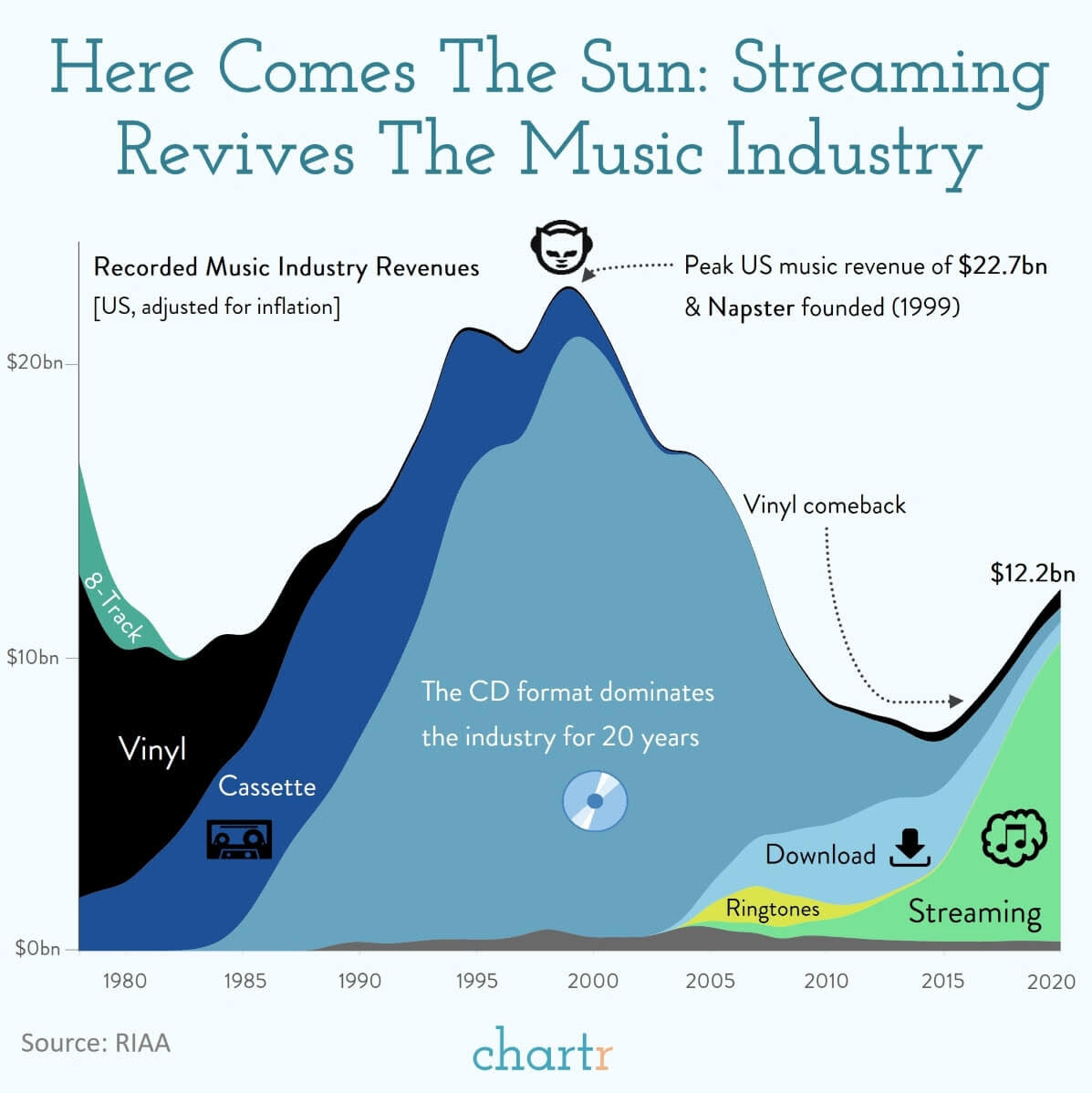
The completeness assumption sneaks in ideological commitments in two ways. First, it effectively endorses the status quo agreement on what goods stand alone, as reflected in how they are packaged and affixed with a price. Rational choice theory does not dictate a correct ordering of that list, true, but it does stack the deck in favor of the dominant theory of what should be on that list. We largely agree that neither verses nor choruses make up unique goods, but individual songs do. The ringtone phase in the music industry is an interesting case study in that regard: It was an experiment in changing the list of goods, and its partial success and ultimate failure demonstrates quite clearly how deliberation about what constitutes a “good” is an ongoing social process.

The second way rational choice theory sneaks in an ideological commitment is by disarming challenges to the status quo. In a sense, there are two ways to interpret a choice. In the rational choice model, my choice reveals my underlying ordering of goods. When I buy lamb in the presence of lower-priced beef, I am expressing an underlying preference for lamb. On rational choice theory, I am rational insofar as my total choices reveal an underlying structure of coherent preferences, having the properties of transitivity, completeness, and in some models at least, “independence of irrelevant alternatives.” My actual preference structure may deviate from coherence so defined, but behavioral economists will no doubt have some kind of label to affix to my imperfect rationality.

Some of the time, we make lamb versus beef choices in a way that expresses an underlying preference. But I would argue that we also make many choices as value experiments to learn what a thing truly is and in what relation it stands to other things. And in many more cases, we deliberately avoid a choice – a choice to not choose – because we are withholding judgment or because we disagree with the framing of the choice. These two approaches – deliberate experimentation, deliberate withholding of judgment – are rational strategies for exploring and revising the list of goods. From the outside, however, the resulting choices may appear incoherent in the rational choice economist’s terms, even as they follow a clear internal logic.

And that is the problem: The deliberative process of defining society’s goods is necessarily a social process involving negotiation. But the rational choice economists have staked out the commanding heights of “rationality” as their own. Those whose internal logic of deliberation results in an incoherent pattern of preferences of the status quo list of goods are disarmed in that negotiation, disqualifying them from participating in their definition of an adult conversation.

When I was a child, I compiled ordered lists: favorite bands, favorite albums, favorite songs on the album, etc. To me, part of putting away childish things has been to give up the lists and the orderings and instead to recognize a thing’s value in how it stands in relation to other things, how it serves them or is served by them. Deliberating with others on the proper relationship between things, between choruses and verses, between dinner and dessert, is precisely what rationality is all about.  

Summer reading 2: more on property rights

Two items on my summer reading list focused on economic growth and the special role played by property rights. For once, Amazon recommended an appropriate follow-up, Katharina Pistor’s The Code of Capital.

Hernando de Soto stressed the importance of formal property rights as the foundation for growth-oriented economic activity. Formal, legal property rights turn otherwise “dead capital” – typically the real estate held by the global poor only by extra-legal and local social conventions – into live capital that can be used to invest in production capacity. Pistor, a legal scholar, lays bare by what alchemy the legal profession turns dead capital into live capital. Her analysis shows how private legal professionals use existing law to create capital out of, well, all sorts of things, really. Whereas de Soto focused on turning dead real estate into live capital, Pistor shows how lawyers have breathed economic life into all sorts of social relationships, thereby revealing to what degree the notions of “property” and “capital” are fluid and historically contingent.

In particular she shows how the formal property rights to land – the foundation of economic growth for de Soto – were first patched together out of a hodgepodge of legal devices. The all-important feature of alienability – the capacity to sell land or deed it over to a creditor – was not a given: It had to be encoded in law and accepted in practice, against other social conventions, e.g. that a family had an inalienable ancestral claim to land, regardless of what might be owed to creditors.

The model of property rights established for land has since been extended to all sorts of other social practices including promises (debt obligations) and ideas (intellectual property).

I’m still contemplating the implications of Pistor’s work, but what stands out to me are the fluidity and contingency of property rights. For example, with respect to whether property is alienable: Although alienability – through sale and foreclosure – is essential if you want to breathe life into capital and create growth, it is not the case that alienability is always desired by those who use lawyers to encode their property formally. On the contrary, lots of effort goes into creating contracts and legal mechanisms that shield property from creditors, or prioritize some creditors’ claims over others’. There is no equilibrium notion of property rights towards which legal practice has tended over time. There is a constant negotiation and renegotiation of what rights property involves, whose rights they are, and what types of things – land, promises, ideas, etc. – can be considered property.

This points again to a central preoccupation of the Ruminathans: What are the rules by which we negotiate in everyday situations?

Summer reading: property rights and social norms

My summer reading list has highlighted some of the interesting questions explored recently.

In The Birth of Plenty, William J. Bernstein’s project is to explain the level of sustained economic growth to which we have been accustomed in the last couple of centuries in the developed world. He attributes 2% average annual real growth to four factors, all of which must operate at the same time:

  • Property rights
  • Scientific rationalism
  • Capital markets
  • Rapid transportation and communication

All of this is well and good, but I have a minor quibble that sets up a major one. After a chapter for each of the factors, analogizing to an automobile, Bernstein describes them collectively as the “engine” of growth that still requires a “transmission”: the division of labor. Cute analogies are a dime a dozen, and this one does not illustrate anything useful about the relationship of the division of labor to the other four factors: He may as well just accept that he has five necessary factors. The reason this minor criticism is important is that both property rights and the implied fifth factor, the division of labor, rest on something more fundamental that Bernstein takes for granted: social norms of cooperation between perfect strangers.

When I specialize in performing music, I throw myself at the mercy of countless other specialists to provision me with all the needful and desirable things that I can no longer produce myself. This only works with a high degree of trust, trust that is ultimately rooted in social norms of cooperation.

In his discussion of property rights, Bernstein refers to the seminal work of Hernando de Soto on that subject. But it doesn’t seem like Bernstein fully understood de Soto’s larger point about property rights:

  • Property rights may be enshrined in formal law, but need not be;
  • Something like property rights almost inevitably arises extra-legally out of local social norms of cooperation;
  • Growth only follows when property rights have been formalized so that strangers can acknowledge and implement property rights such as selling property, and crucially, accepting it as collateral for debt financing;
  • Finally, that formal property rights have historically emerged as a confirmation and extension of the extra-legal claims to property based on local social norms, and not in conflict with them.

De Soto claims that only a particular type of property rights with a particular lineage launches growth and accounts for the difference between the developed and developing world: formal property rights that emerge from and align with the informal local social norms of property possession.

In de Soto’s (among many others) model, what supercharges growth is the ability of entrepreneurs to turn stored value – particularly ownership of real estate – into capital, allowing savings to turn into the investments that lead to higher productivity and therefore more goods and services. You can much more easily and at much lower cost turn your saved value into capital – for example by mortgaging your house to raise cash – when there are formal rules that allow perfect strangers to lend to you with confidence. When perfect strangers know that a loan to you is backed by property they can foreclose on in the worst case, the cost of borrowing will be driven down by competition among lenders. But those formal rules – laws – have to coincide with the social norms of property possession; otherwise they will be ignored. De Soto’s research revealed that this is precisely what has happened in developing nations, where formal property rights are only relevant to a privileged few, with the vast majority of the people inhabiting a parallel, extra-legal universe characterized by predictable and strong, but merely local, social norms of property possession. Because property claims are not recognized outside of a limited local range, savings cannot be turned into productivity-enhancing investment, and growth remains subdued, no matter how hard and how smart people in developing countries work. And as someone who has been privileged to travel quite widely, there is no doubt in my mind that people in the developing world have a more “Protestant” work ethic and greater ingenuity than what I witness anywhere in the developed world I know well (USA, Germany, France).

Growth rests on access to capital; capital rests on formal rules of property rights; but formal rules must align with local social norms. To understand growth therefore, you have to understand the nature of the social norms of cooperation that eventually get formalized and extended.

Whose risk is it anyway (part 2)?

Who takes on more risk: capital or labor?

This post continues my reflections on the capital return: If we compensate people for taking risk, what do we mean by risk?

Alice – a capitalist – provides a tool to Brian in exchange for a portion of what Brian produces with that tool. Suppose the tool is an axe and the produce is firewood. Brian would take the axe, chop enough wood for himself and his household. In the contract we call debt he would agree to return the axe (or an equivalently good one) at a specific point in time and hand over a fixed amount of firewood, what we call interest. In the contract we call equity he could keep the axe indefinitely but he would have to give Alice all the wood he managed to produce over and above an agreed amount, but at least enough to cover Brian’s firewood needs. That’s what we call profit. And Alice would be able to demand the axe back at any time and give it to someone else.

In both arrangements, some risks are faced by both Alice and Brian, e.g., Brian fails to find suitable trees. But Alice additionally faces the risk that Brian will misrepresent how much wood he needs, or conceal some of his produce, or take off to distant shores along with the axe and the firewood. Initially it looks like Alice bears a layer of risk over and above what Brian bears.

This is the justification of the capital return: The provider of capital must be compensated for the incremental risk she takes by forgoing the use of her capital. And the incremental risk that her counter-party, labor, does not bear is the risk that labor welshes on the deal. There may be other risks, but they would have been borne by the capitalist if she had used the capital herself.

In the previous installment I pointed out that this is not the full story. The user of a tool takes on many risks that the capitalist owner of the tool does not. Hence the axe as a telling example: Felling trees is a dangerous activity. If you owned an axe but could get someone else to produce firewood for you, that person would be supplying a risk-mitigation service in addition to the provisioning service. If risk is something that ought to be rewarded, something that generates a legitimate claim, then using a dangerous tool on someone’s behalf ought also to be rewarded. Hence my previous argument that, if the capitalist has a moral claim on a capital return based on risk she uniquely bears, then labor has a claim on something like health and disability insurance; a claim whose legitimacy is rooted in the same foundation as the capitalist’s claim to her return.

Are there other risks that are unevenly distributed between capital and labor?

If there’s one thing the world of investment teaches us it’s the value of diversification. Every investor knows that she can mitigate risk by spreading her capital across asset classes, currencies, sectors, issuers, etc. By doing so, she likely gives up some potential reward. But in return, she almost certainly preserves her capital. With highly developed capital markets, a capitalist can generate a stream of income – her capital return – from a nearly infinite array of sources.

Can a laborer do the same?

Clearly not, at least not as a laborer. For one thing, there are practical upper limits on the number of employers from whom an employee can generate an income. Never mind the restrictions an employee would have on working for competing companies, a restriction no investor faces: Nowadays, via index funds, it’s likely the average investor owns shares and debt of competing companies. In other words, while an investor can choose to take on concentration risk and potentially earn a higher reward, an employee is forced to concentrate.

Especially in the context of accelerating innovation, employees face an additional risk out which they – unlike investors – cannot diversify: obsolescence risk. Innovation goes hand in hand with increased innovation-oriented specialization, which in turn goes hand in hand with education and training. But a new technological development can make your specialization and education obsolete overnight.

Meanwhile, acquiring new specializations requires an ever-increasing investment in new skills. How many career leaps can you really make? Chances are, you will be forced to step down to a lower-skill, less remunerative job when your coal-mining skills become obsolete, rather than being able to re-skill to coding, wind turbine installation, or brain surgery. Meanwhile, an investor can place simultaneous bets on coal, natural gas, solar power, and cold fusion with just a few keystrokes.

So: Who is the bigger risk-taker – capital or labor?

I do not think the answer to this is simple. Which is why I believe we have to, as a society, come to grips with what we mean by risk, and place it front and center in political economy.

Revere the greats, sure. But read them?

One of my college philosophy professors told the story about how his thesis adviser had a conversation with Michel Foucault, telling him: “Michel, in our conversation, your ideas are clear, but I cannot fathom your writing.” To which Foucault supposedly replied “Yes, but if I did not write that way, nobody would take me seriously.”

The last few weeks I’ve been slogging through some particularly difficult texts (e.g. by Niklas Luhmann and Jacques Derrida). I’ve long been persuaded that many writers, especially in academia, and especially in Germany and France, write intentionally obscurely to create the impression of profundity.

But of course, by attributing intentional obscurity to writers I am violating my cardinal rule of communication: Don’t attribute motives to others you would not want them to attribute to you. Searching for a more charitable interpretation of obscurity I realized again how much we take word processing for granted. No text older than 30 years – essentially everything that has weathered enough controversy to be considered a classic – benefited from this magical ability to cut and paste at no cost. Going even farther back in time, paper and ink become significant expenses and the kinds of revisions we now do reflexively – move a paragraph, strike a clause or a whole tangent – become prohibitively costly.

Curiously, thinking about classic texts this way has had two effects. On the one hand, I am in greater awe of the luminaries and their ability to think profoundly and put down their thoughts in grammatically sound, intricately structured texts. At the same time, I feel much less guilty about avoiding original sources. They were not writing for a world inundated with information, and they did not have the tools to hone their ideas to needle-sharp arguments.

The explosion of content and the new tools we have for creating it should – and will – change our approach to preserving and transmitting our intellectual heritage. It’s fine if some people delight in becoming experts on Hegel. But the reason we should be willing, as a society, to provision them – and don’t get me wrong, we should – is that they deliver to us Hegel’s central ideas, polished to perfection, in a way that stands out against the morass of unintelligible gibberish produced daily.

One of this blog’s preoccupations has been the right and wrong of how we communicate with each other. I would go so far as to say that, given the firehose of content and the tools we have at our disposal, we have a moral obligation to prune our own arguments as well as those of the giants on whose shoulders we stand.

All of us need classic ideas and arguments as we wrestle with the eternal questions, like what we owe each other and how to live a good life. I am grateful to those who first developed those ideas. And I’m equally grateful to those who curate and condense them for everyday use. We could use more of the latter.