We cannot afford what we do not produce: social security, demographics, and the hidden cost of innovation

Across the developed world, hands are wringing vigorously about the sustainability of public pension schemes. Due to changing demographics, fewer and fewer workers will have to support more and more retirees.

What gets lost in the debates about the solvency of Social Security or similar programs is that the problem is not caused by the public nature of the scheme. Any conceivable private alternative would face the same underlying challenges. And those underlying challenges lie at a deeper level than demographic change.

Misfortune, senescence, and our long childhood

More than any other creature, we humans face a unique set of survival challenges:

  • Misfortune: Our own productivity is subject to variation for reasons beyond our control, whether from illness, climate variation, or monetary policy
  • Senescence: We are likely to live beyond our ability to provide for ourselves
  • Long childhood: We arrive in this world unable to provide for ourselves, and we have to learn survival skills through a long phase of cultural transmission.

To address these challenges, working adults have to produce surpluses. We have to produce more goods and services than we can consume, and we have to find ways to store the surplus against both rainy days and old age. But no matter how productive we are, and no matter how ascetically we live, we cannot individually store enough food, water, shelter, medical supplies, etc. to get by for more than a few months, maybe a year at best.

At its simplest, we solve the problem with the intergenerational compact in which working adults provision their elderly parents while raising their own children. But we’ve always mutualized that compact beyond our immediate bloodline. Whether as hunter-gatherers, pastoralists, agriculturalists, industrial workers, or knowledge workers: We have always had to throw ourselves at each other’s mercy, paying forward some of what we don’t consume today. In turn, we look to others to provision us in our times of need. “What goes around comes around” is our great hope.

Project Civilization has been about creating institutions to buttress that hope. Central distribution hubs to store food (aka cities). Credit contracts and written records thereof. Private property. Insurance. The thing we call “money.” All those institutions are grounded in our collective will to allow a state to enforce these arrangements. With rule-bound violence if necessary.

Because it’s ultimately the state’s enforcement capacity that keeps our hopes credible, we’ve even short-circuited these institutions and have asked the state itself to collect and redistribute surpluses. That’s what public pensions like Social Security do. And that’s equally the premise of publicly funded education for our children and income security programs such as unemployment insurance to handle misfortune.

It doesn’t matter which mechanism we use: Whether collected by the state, saved in money, or invested in private enterprise, without surpluses generated by others there is nothing to store and nothing to distribute.

Demographic change: cause or effect?

The problem with our pension systems is not in how they are financed. The problem is that the working age population may not produce enough surpluses to simultaneously provision the retired and provision and invest in the next generation. It’s not about surpluses of money. It’s about surpluses of goods and services.

Economists speak of the age dependency ratio. There are different formulations thereof, but in its simplest form, it’s the ratio of the population under 15 or over 65 to the working age population between 15 and 65.

The naïve narrative about the looming crises in public social security systems is about demographic change. On the one hand, extended longevity has meant that people spend longer in the “retirement” phase where they cease to be net surplus generators. On the other hand, we are having fewer children, which means that there are fewer surplus-generating adults.

In the naïve telling, when we set up our public pension systems, we assumed our population would stay pyramid-shaped forever, with a few surviving retirees supported by an ever-widening base of new workers. In the US, the ratio of worker to beneficiary went from 3.3:1 in 1985 to 2.8:1 in 2021. I’m using 1985 as the baseline because that is 45 years after the first Social Security payment, so roughly when the system should have hit a steady state.  

According to the mid-point projections, the US is headed towards a ratio of 2.1:1 in the next decades. In countries like Germany, with lower birth rates and lower immigration, the ratio is already 2:1, with projections taking the number of workers per beneficiary even lower.  

The naïve story comes with naïve policy recommendations: People should work longer (US, Germany). We need “pro-natalist” policies incentivizing women to bear more children (US, UK). We should privatize social security (US, Germany).

And the ultimate policy recommendation is always: We have to increase productivity with our tried-and-true approach of greater labor specialization enabled by more technology.

The fact that the explanation of the problem and the recommended solutions are naïve (at best) or proposed in bad faith (at worst) is illustrated with two simple observations:

  1. The problem exists whether the mutualized surplus-storage solution is organized privately or publicly.
  2. Any system – public or private – built on indefinite exponential growth of the number of human beings on the planet is absurd from the get-go.

I would like to take the analysis of the underlying problem a step deeper than demographic change and the dependency ratio. I will show that causes and effects are intertwined, the policy measures miss the point, and “more technology” cannot always be the answer because it’s often the problem.

The intensification of child-rearing

Let’s start with another naïve observation. Fewer children should also mean fewer “unproductive” mouths to feed and more time available to generate surpluses. So on the face of it, having fewer children could also alleviate the problems facing pension schemes. In fact, economists speak of a demographic dividend that accrues when societies reduce their birth rates. This is a point we’ll return to a little later.

But having fewer children doesn’t necessarily mean we need fewer surpluses if the amount of resources dedicated to child-rearing intensifies. It’s one thing to have seven children when you live on a farm in a low-density settlement and can count on them to start contributing to farm production from a very young age. Or to have five children in a cramped one-room apartment in a high-density city if you can send them to shovel coal into a factory’s furnace, and that’s all the job that will ever be available to them.

If, however, becoming productive in a hyper-specialized, knowledge-based economy entails 16-30 years of dependency, 10-24 years of which are devoted to resource-intensive education, then you may not have the resources to afford two children, let alone five or seven. The US Department of Agriculture estimates the cost of raising a child born in 2015 at $233,610. Crucially, that is the cost for raising children to age 17 and does not include college education and job training, nor the provisioning of young adults until they become net surplus generators. Nor does it include the opportunity cost – borne mostly by women – of parents who take off time during pregnancy and earliest infancy.

The high cost per child in places like the US might partly reflect overly generous consumption. There’s some truth to that. But the fact remains that when labor becomes hyper-specialized and knowledge-based it requires more resources to get to the point at which you become productive. It’s not just the basic needs and education. The more specialized and the more knowledge-based the economy, the harder it becomes to objectively measure whether someone has acquired knowledge and skills. Effort and resources go into signaling: prestigious degrees, resumé-padding activities, exclusive networks, fine clothes, all the things that might be subsumed under that horrid but real concept of a “personal brand.”

Raising the next farm hand or coal miner simply did not take the same amount of resources as raising the next oncologist, robot-plant operator, or social media influencer.

Pro-natalist economic policies like tax breaks and subsidies have been tried in many countries. They rarely and barely move the needle. And it’s not hard to see why. Having one to two kids on average is as much as we can afford on average.

The root cause is ultimately not that people don’t want to have children. The root cause is the amount of investment it takes to get children to be productive in the high-technology, hyper-specialized economy.

Insofar as “more technology” increases specialization and increases the need for learning, it may not contribute to the solution of inadequate surpluses. It cannot be a default answer to the problem.

Age or skill obsolescence?

The adult worker gets squeezed at both ends. With a bit of poetic license: She has to work and scrimp for 50 years to raise her child through 25 years of education to become the geriatrician she then has to pay to keep her parents alive during 25 years of retirement.

When our pension schemes were devised, they assumed people would be net surplus providers until around 65, then live off the next generations’ surpluses before shuffling off their mortal coils at around the biblical three-score and ten years.

Yes, people now live longer. And not just that: They haven’t magically started to live longer. They live longer because we’ve unlocked ways to keep people alive longer. Those medical technologies are miraculous. But they also consume massive amounts of resources and labor. My father had a medical procedure that could have extended his lifespan by a decade or two but that cost somewhere close to the median after-tax annual salary. In his case, it failed, sadly.

Rather than retirement being a phase of reduced consumption, it often involves an intensification of consumption. Peering beyond the veil of money to the underlying real economy of goods services: We train and provision geriatricians and oncologists who might otherwise have become schoolteachers and carpenters.

Historically, however, old age did not mean you stopped contributing. You shifted your contributions from, say, hunting and gathering, to childcare and cooking. That’s what freed others to do the surplus-generating hunting and gathering. And childcare meant imparting the skills and knowledge required for children to become net surplus producers. Or knowledge about how to survive once-in-a-lifetime ecological crises.

Age is not the problem. The problem is living beyond the obsolescence of your skills. As technology changes, the skills and knowledge you acquired when you were young – the ones that enabled you to generate net surpluses – are now likely to become obsolete in the span of your lifetime. Sometimes more than once.

In some professions, it is possible to retain a high enough level of productivity to be a net surplus generator past age sixty-something. But probably not in the majority of professions. Whether you “retire-in-place” and still pull a salary, or spend time retraining to become productive in another domain, you are de facto benefiting from others’ surpluses in that moment. Through no fault of your own.

In a world in which technological obsolescence and global labor specialization can destroy your community’s economic foundation overnight, working adults have to be mobile. So the option of shifting from direct surplus generation to indirect support by providing childcare is not open to every retiree. And even if it is, many of the life skills he has to impart might as well be from the Stone Age.

Demanding that people work past 67 is likely to be as ineffective as tax breaks for having more children. As for lower fertility rates, the real root cause is the rapid pace of technology-enabled labor specialization.

Misled by nostalgia

We face interlocking constraints that are both causes and effects.

  1. The resources and time required to become and stay productive are increasing.
  2. People live longer past the obsolescence of their skills.
  3. The horizon over which our skills are valuable is decreasing.

The dependency ratio – even in its elaborations – does not capture the reality of our predicament if it is not weighted by the intensification of child-rearing and eldercare, and the risk of obsolescence.

It’s a largely unchallenged dogma that technological and organizational innovation solve more problems than they create. However, we may have passed a point where that’s true.

Much of what we believe is rooted in nostalgia about the period known as the post-war boom known in France as the Trentes Glorieuses (“The Thirty Glorious [Years]”) and the Wirtschaftswunder (“Economic Miracle”) in Germany. Whether we experienced it directly or not, that period has shaped our collective consciousness. It birthed youth culture and rock’n’roll, and all the values, beliefs, and expectations we hold onto, no matter where we fall on the political spectra.

But the Trentes Glorieuses were an anomalous happy optimum where:

  1. The investment in skills required to become productive was not too onerous, meaning children became net surplus generators more quickly.
  2. Because children became net surplus generators more quickly, people could also afford to have more of them.
  3. You could count on your stock of skills to see you through 40-50 good years of surplus generation without becoming obsolete.
  4. People did not live for decades beyond the obsolescence or deterioration of their skills.

In contrast, now we face a world in which technological innovation extends our lives at great material cost, while rapidly rendering obsolete the skills we so heavily invested in. Both factors impose a set of constraints such that we can invest only in one or two children, if any at all.

We face this predicament globally, though its urgency will hit different countries at different speeds for historically contingent reasons.

“More technology!” is the answer for many: Make the fewer and fewer people more and more productive thanks to machines and AI. But if AI actually undermines skill development faster or more deeply than it augments human ability, the calculation will not work out.

But that is another essay and will be expounded another time.
Was the grass greener on the other side of the pond?

“The more troubling aspect is not that Germany is currently about 30% behind the United States in GDP per capita terms. What concerns me more is the relative deterioration over just one generation.”

That is an excellent point raised by my friend Detlef in a comment on my previous post (thank you, Detlef!), and one I should have addressed. It captures where a lot of the Sturm und Drang comes from among politicians and pundits in Europe in the face of US economic “outperformance” as measured in per capita GDP. It’s not the absolute difference in terms of GDP per capita, it’s the trend that counts, and that trend is deterioration.

Detlef’s concern motivates an overall narrative (which I won’t ascribe to Detlef) that European countries like Germany are in decline relative to the US because they are over-regulated and over-taxed, and because the US works harder, with more creativity and risk-taking. While Germany tied itself up in regulatory knots to prevent climate change and taxed its Macher (“movers and shakers”) to death (or into exile), the US unleashed Steve Jobs, Elon Musk, and Sam Altman to bring about the 4th Industrial Revolution.

Or so the story goes.

It’s a satisfying narrative for those in the US who like to self-congratulate and for those in Germany who’ve been brought up to self-flagellate. There may be a kernel of truth to it, as there must always be to any narrative that resonates. But the data don’t support it. Let’s look at the trend.

I’m going to use 1995 as a baseline for the trend comparison. Partly because it’s a neat 30 years. Partly because it corresponds nicely to the dawn of my own economic awareness. And partly because it corresponds roughly to the “information age.”

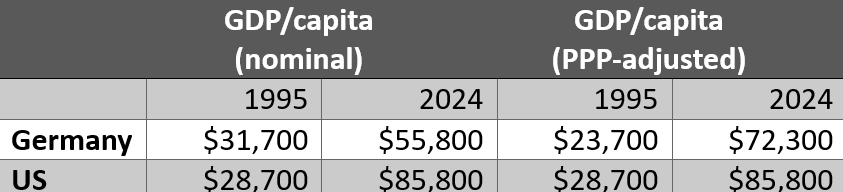
When Detlef wrote that “Germany is currently about 30% behind the US in GDP per capita terms” he is – like Yasha Mounk – referring to raw GDP per capita numbers: $55,800 versus $85,800 (2024; all figures sourced from the World Bank database again unless otherwise indicated). And indeed, if you look at 1995’s raw numbers, Germany had higher per capita GDP than the US: $31,700 versus $28,700.

But these figures ignore relative pricing levels. When you take pricing levels into account, you see that Germany’s per capita GDP was actually lower than the US’s: $23,700 versus $28,700 (the US’s price level is used as the reference, so the US’s PPP-adjusted per capita GDP is identical to the un-adjusted value). That’s a difference of 21% — 21% higher PPP-adjusted GDP per capita in the US in 1995 than in Germany.

Today that difference in PPP-adjusted GDP is 19%: PPP-adjusted GDP’s per capita of $72,300 versus $85,800. So while the average American is “richer” than her German counterpart, that was also the case 30 years ago, and if anything, Germany has “caught up” slightly.

Poof goes the narrative.

But how can this be? Didn’t Silicon Valley change the world while Germans took six-week vacations and called in sick whenever they sneezed more than twice in two minutes? Didn’t tech superheroes enrich our lives with free maps and on-demand-streaming while German engineers dithered around with obsolete internal combustion engines?

Part of the narrative is that American job-creating maverick entrepreneurs broke all the rules and created a crazy new world in which high-paid coding wizards cruise to work in their self-driving Teslas and then return to the kinds of glam downtown apartments you see on Friends and Sex in the City. But those rule-breaking mavericks may have destroyed a bunch of industries and jobs as well. It is called creative destruction after all. It’s not a given that technology makes people richer in aggregate, though it may make individual people rich.

But what’s important to understand about the information technology sector is that – whatever impacts on GDP per capita it might have – those impacts have not been disproportionately recorded in US GDP, or not wildly so. The consumption of those goods and services, the labor used to produce them, the supply chains of the IT industry, and even the financing are all globalized. At the end of the day, America can claim some bragging rights for birthing brands like Apple, Google, Facebook, and Microsoft, but in terms of GDP contribution, the value creation is spread all around the world. So while the tech sector may have generated a lot of GDP growth it will have done so globally.

The healthcare sector is a different beast. Its value chain is much more domestically based. Both the US and Germany have experienced disproportionate growth in their healthcare sectors – annual growth higher than GDP growth – since 1995. The sources I found indicate growth of 268% and 477% of growth in health spending, respectively in Germany and the US (caveat: I cannot tell from either source whether these numbers are adjusted to the respective countries’ inflation rates).

Both countries have seen their populations age over those three decades, though Germany’s more so. So given that Germany is older, and given that the US’s health outcomes are worse, it is strange that the US’s economy has become so much more dominated by the healthcare sector than Germany’s has. I can’t help but see this as a literally “unhealthy” development.

It certainly invites a different narrative than the one about the job-creating innovators unfettered by regulations and taxes. Instead, it invites the story of a nation of nursing home attendants working themselves sick in order to pay the medical bills for their sickness. Not to mention their legal bills for suits against the insurance companies who denied them coverage, and the interest on their student loans for a degree in communications from the University of Phoenix.

There’s a kernel of truth to that narrative, too. Perhaps more than a kernel as my previous post tried to argue.

In any case, there is no good case to be made that Germany’s per capita economic position has deteriorated relative to the US’s over the last 30 years.

That does not mean that Germany is not at an inflection point now, and that it may need to do something – maybe even dramatic things– to adapt to an aging population and the decline of the internal combustion engine. But there’s no need for self-pity. And no need for Elon-envy.

Is the grass greener on the other side of the pond?

Jane works three jobs and generates an after-tax income of $78,000. This income suffices to make ends meet. Beyond food, utilities, and shelter, her ends that need meeting include:

  • Treatment of various medical conditions created or exacerbated by her inability to find time or energy for rest, recreation, and exercise.
  • Legal bills due to lawsuits with a former employer, a medical service provider, and a restaurant whose undercooked pork dish resulted in one of her chronic illnesses.
  • Servicing a loan for an education at a private college that has no bearing on any of her three jobs, but whose credential she needed to differentiate herself in the job market.

Johann works a single job and generates an after-tax income of $50,000. This income suffices to make his ends meet:

  • He has ample time for rest, recreation, and exercise, and so he has no chronic illnesses.
  • The regulatory environment he inhabits has established clear rules for employers, healthcare providers, and restaurants so that individual cases do not need to be adjudicated in courts.
  • The educational institutions in his country are standardized and do not compete with each other for the signaling value of their credential.

Who is “doing better” – Jane with her $78,000 income or Johann with his $50,000 income? And what will per capita GDP tell us about the relative economic success of a nation composed of Janes and a nation composed of Johanns?

I am an American living in Germany, and I read media from both sides of the pond. And on both sides, a narrative has taken hold that the US economy has been more “dynamic” or achieved better outcomes in the last two decades, based on the observation that GDP has grown more rapidly in the US. (The most recent example I could recall is by Yasha Mounk, but it’s just one of many of its ilk.)

Unambiguously, Germany has a lower GDP per capita than the US, and the gap has widened since 2000. The raw data from 2022 shows a huge gap: $49,700 versus $77,900, i.e., the US GDP per capita is nominally about 55% higher (Unless otherwise stated, the data come from the World Bank’s Data Catalog which can be downloaded as a spreadsheet). The trend has widened since then (Mounk uses an even wider gap to make his point; nonetheless I will use 2022 numbers because I found World Bank data for the main variables I wanted to investigate only up to 2022).  

However, the raw numbers do not take into account different pricing levels. I’m not sure why Mounk does not acknowledge that, especially because the concept of “purchasing power parity”(PPP) is well-known and the data are readily accessible. When you use those figures, the gap shrinks to $5,200 or 10%.

The question is: Does that mean Janes are better off than Johanns? And should Germany (and other European nations) emulate US policy to “catch up?”

GDP tracks economic activity insofar as it can be observed through monetary transactions. Not all measured economic activity is a sign of human flourishing. And not all flourishing-enabling activities are measured. Hire a chauffeur and his income contributes to GDP. Marry him and it drops back out.

GDP is an imperfect measure, and all economists know this. The question is whether even developed economies like the US and Germany differ systematically in how poorly they capture actual value-adding economic activity.

In the discussion to follow, I will look at how the US records more economic activity in three crucial areas that collectively account for much (possibly all) of the PPP-adjusted GDP per capita gap, and I will argue that these are areas that can profoundly mislead about welfare and prosperity.

Healthcare

In the argument that actual American Jane’s are not really better off than actual German Johann’s, whatever per capita GDP might say, healthcare weighs the heaviest. Healthcare obviously contributes to human flourishing. But if Johann spends €0 on healthcare in a given year, there might be two reasons. One would be that healthcare was unaffordable for Johann. But the other would be that Johann just didn’t get sick. We can agree that a world in which Johann didn’t spend because he didn’t get sick is better than not spending because he couldn’t afford treatment. But it’s also better than a world in which he was sick and generated €1000 of economic activity in healthcare services and products.

In a meaningful sense, the “best” world would be one in which no healthcare spending took place because diseases and accidents didn’t happen.

So one thing to investigate would be whether the US experiences more illness than Germany, generating more healthcare-related economic activity than Germany does. If so, then that’s economic activity Germany can happily do without. What are the numbers?

In 2022, the US spent $12,434 per person on healthcare versus $8,453 spent per capita in German. Importantly, these figures are adjusted for purchasing power parity already (the gap is wider if the raw numbers are used). That means the average Jane spends $4,000 more on healthcare than the average Johann, and not just through higher prices. She truly consumes more healthcare services.

Now it would be one thing if Jane could point to better health outcomes: She can afford an additional $4,000 of healthcare spending compared to Johann, and has better health to show for it. But it is hardly news that US health outcomes, measured along metrics such as life expectancy and infant mortality, are inferior (easily confirmable in the World Bank data). So the US pays more for less. As unnewsworthy as that is, what hasn’t been highlighted as much is how much of the US’s outperformance is due to its sicker state. Out of the $5,200 per capita GDP gap, $4,000 of economic activity is due to being sicker!

The remaining gap, $1,200, is 2.5%.

Are there other economic activities Americans spend money on that might not really be signs of human flourishing?

Legal services

A world in which people never have a need to sue each other is better than one in which they can’t afford to get justice. But it’s also better than one in which they can afford to get justice and have to avail themselves of the courts.

The US and Germany have different legal traditions and approaches to regulation. Loosely speaking, Germany makes rules in advance: rules designed to prevent undesirable outcomes, e.g. pollution, medical malpractice, etc. There’s no shortage of discussion about how burdensome Germany’s regulation can be. But having rules devised in advance gives economic actors some planning certainty and levels playing fields for competitors.

The US leaves much up to the courts to sort out after something bad has happened. The “freedom” from regulation means that you have to be worried that someone will sue you for something later on, possibly spuriously. And the battle in the courts is an arms race, in which the side that can afford to “lawyer up” the most may well win the day, regardless of the merits.

How much measured economic activity originates in the legal profession in the US and in Germany, respectively? This is a bit harder to tease out because it’s not in the World Bank data. But the direction is clear. In 2023, American Janes spent a total of $363 billion on legal services. I failed to find exact numbers for 2023 in Germany, but in 2024 it appears to have been around $36 billion. So the US has to spend around ten times as much on legal services in an economy that is only six times the size.

The comparison of economic activity due to the legal profession is less clear cut than the healthcare situation, and it’s also a smaller factor. But I wanted to highlight it for three reasons:

  1. Americans are famously litigious, but I hadn’t seen the measurable economic impacts.
  2. One of the policy comparisons people like to make between the US and European nations like Germany is the supposedly lower level of regulation with supposedly beneficial impacts on economic activity; this is, however, never juxtaposed with the costs of the American approach of case law and the threat of expensive civil liability.
  3. If you run the legal expenditure numbers on a per capita basis, you get to a difference on the order of around $600, which would make up half that remaining gap of $1,200 in relative per capita GDP.

Legal expenses can have an arms race character: You spend not to get quality per se, but to get a quality edge compared to your rivals. Everyone (except the lawyers) would be better off in a legal dispute if they all simultaneously agreed to “disarm” and spend less. But as in a military arms race, it can be hard to reach such an agreement, especially not with a rival or foe.

A society that is spending on competitive arming for military and legal battles is not spending on things that improve the lives of its citizens. Are there other sectors with such an arms race character?

Education

Learning unambiguously delivers social and private benefits. But a lot of education spending is not about the capabilities you are building. It’s about the signaling value of your credential. Instate tuition at the University of Texas (UT) is currently around $12,000 annually. Annual tuition at Harvard is around $60,000. I could be persuaded that there are some differences in quality in the learning experiences between the two. But it’s hardly controversial that you’re paying five times as much to be able to drop the H-bomb in the dating and job search games.

According to OECD data, the US spends about $20,400 per student on education (all levels including tertiary and R&D, and including public and private spending). The comparable figure for Germany is $17,200. These are 2024 numbers, as they were the most readily available, so it wouldn’t be 100% clean to compare them to the 2022 numbers I used for the most important factor, healthcare. Still, this shows the directional difference. These are PPP-adjusted numbers, so the US is spending more on education even after accounting for price levels.

Crucially, if you look under the hood, the US spends slightly more on primary and slightly less on secondary education than Germany does, and in both cases, the vast majority of the spending is public. But in tertiary education, where a greater proportion goes to private institutions like Harvard (and where even “public” institutions like UT are partly funded by individual tuition), the difference is enormous: $22,000 for Germany vs. $36,200 in the US.

Whereas stats like life expectancy and infant mortality demonstrate pretty clearly that the US is driving some of its measured economic activity from unwanted illness, it’s harder to pinpoint whether the US might actually be getting a better or worse educational outcome for its higher spending on education. Meanwhile, Germany has some of its own arms race dynamics when it comes to academic credentialing, as demonstrated by its many political scandals of politicians resorting to plagiarism to attain PhDs.

But at least some of the US’s excess spending on education must be attributable to the signaling arms race.

I won’t elaborate on the financial services at length. But it’s worth observing that the higher spending on tertiary education is financed predominately through loans rather than through taxes. That means the raw spending on tertiary education understates the amount of actual spending by the amount of interest students pay on their debt. Those interest payments contribute positively to GDP and are one – of very many – reasons that FIRE (financial services, insurance, and real estate) make for a bigger proportion of GDP in the US than in Germany. (The US spends around $6.3 trillion on FIRE, and Germany spends around $550 billion. So more than ten times as much spending on FIRE in an economy only six times larger).

I question whether the interest paid on the excess cost of education caused by the credentialing arms race contributes to human flourishing.

What about housing?

Arguments like Mounk’s see the need to not just compare raw numbers – even when they fail like Mounk’s to take into account pricing levels – and to try to identify ways in which the higher incomes translate into observable human flourishing. Mounk’s main case relates to housing: Specifically the relative sizes of average US and German homes: 2200 versus 1200 square feet (here’s his source).  

He correctly points out that more “space” may or may not be intrinsically good, but that it affords the option to have more things, including very attractive time-saving things like dishwashers and dryers.  

Although this is true, he fails to take into account that bigger houses are not really caused by policy differences and economic dynamism. It’s substantially a matter of density and available land.

And while it’s nice to talk about the positive aspects of big houses, especially when things like dishwasher and drier purchases contribute to GDP, it’s also important to highlight the downsides.

Greater density means that I have option value when it comes to choosing transportation in Germany: I can get from A to B in daily life by car, by public transport, on foot, or by bike. All four are realistic, safe alternatives. When I lived in the US, many trips were not viable by anything but car. Biking and walking contribute much less to GDP than driving, but may have the same impact on my flourishing (or arguably, much more).

All this by way of saying that “Americans live in bigger houses” is weak evidence for their greater prosperity, and even weaker evidence for the superiority of American economic policy or business culture.

Conclusion

The subtext of these articles comparing per capita GDP is always “Europe has been doing something wrong in its economic policy,” and “the US model is worth emulating.” I can understand why the raw numbers suggest that. And there may be interesting questions to ask about why the US’s information technology sector is so strong compared to Europe’s.

But to jump from raw GDP numbers to the conclusion that European economies are underperforming where it counts –creating value for citizens – is unwarranted. If there’s more measurable economic activity going on in the US because Americans are sicker and competing in more arms race-type games then I don’t think Europeans should believe the grass is greener on the other side of the big pond.

Europe should look at itself and say “we could be doing better (and we’ll have to because of an aging society).” But it need not look to the US for a model to emulate.