Was the grass greener on the other side of the pond?

“The more troubling aspect is not that Germany is currently about 30% behind the United States in GDP per capita terms. What concerns me more is the relative deterioration over just one generation.”

That is an excellent point raised by my friend Detlef in a comment on my previous post (thank you, Detlef!), and one I should have addressed. It captures where a lot of the Sturm und Drang comes from among politicians and pundits in Europe in the face of US economic “outperformance” as measured in per capita GDP. It’s not the absolute difference in terms of GDP per capita, it’s the trend that counts, and that trend is deterioration.

Detlef’s concern motivates an overall narrative (which I won’t ascribe to Detlef) that European countries like Germany are in decline relative to the US because they are over-regulated and over-taxed, and because the US works harder, with more creativity and risk-taking. While Germany tied itself up in regulatory knots to prevent climate change and taxed its Macher (“movers and shakers”) to death (or into exile), the US unleashed Steve Jobs, Elon Musk, and Sam Altman to bring about the 4th Industrial Revolution.

Or so the story goes.

It’s a satisfying narrative for those in the US who like to self-congratulate and for those in Germany who’ve been brought up to self-flagellate. There may be a kernel of truth to it, as there must always be to any narrative that resonates. But the data don’t support it. Let’s look at the trend.

I’m going to use 1995 as a baseline for the trend comparison. Partly because it’s a neat 30 years. Partly because it corresponds nicely to the dawn of my own economic awareness. And partly because it corresponds roughly to the “information age.”

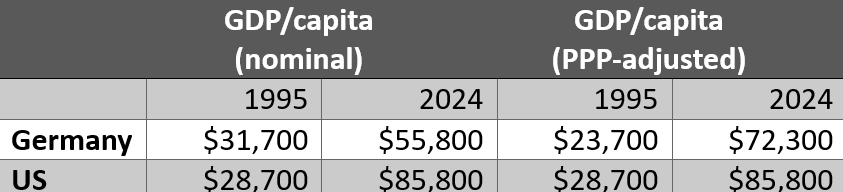
When Detlef wrote that “Germany is currently about 30% behind the US in GDP per capita terms” he is – like Yasha Mounk – referring to raw GDP per capita numbers: $55,800 versus $85,800 (2024; all figures sourced from the World Bank database again unless otherwise indicated). And indeed, if you look at 1995’s raw numbers, Germany had higher per capita GDP than the US: $31,700 versus $28,700.

But these figures ignore relative pricing levels. When you take pricing levels into account, you see that Germany’s per capita GDP was actually lower than the US’s: $23,700 versus $28,700 (the US’s price level is used as the reference, so the US’s PPP-adjusted per capita GDP is identical to the un-adjusted value). That’s a difference of 21% — 21% higher PPP-adjusted GDP per capita in the US in 1995 than in Germany.

Today that difference in PPP-adjusted GDP is 19%: PPP-adjusted GDP’s per capita of $72,300 versus $85,800. So while the average American is “richer” than her German counterpart, that was also the case 30 years ago, and if anything, Germany has “caught up” slightly.
Poof goes the narrative.

But how can this be? Didn’t Silicon Valley change the world while Germans took six-week vacations and called in sick whenever they sneezed more than twice in two minutes? Didn’t tech superheroes enrich our lives with free maps and on-demand-streaming while German engineers dithered around with obsolete internal combustion engines?

Part of the narrative is that American job-creating maverick entrepreneurs broke all the rules and created a crazy new world in which high-paid coding wizards cruise to work in their self-driving Teslas and then return to the kinds of glam downtown apartments you see on Friends and Sex in the City. But those rule-breaking mavericks may have destroyed a bunch of industries and jobs as well. It is called creative destruction after all. It’s not a given that technology makes people richer in aggregate, though it may make individual people rich.

But what’s important to understand about the information technology sector is that – whatever impacts on GDP per capita it might have – those impacts have not been disproportionately recorded in US GDP, or not wildly so. The consumption of those goods and services, the labor used to produce them, the supply chains of the IT industry, and even the financing are all globalized. At the end of the day, America can claim some bragging rights for birthing brands like Apple, Google, Facebook, and Microsoft, but in terms of GDP contribution, the value creation is spread all around the world. So while the tech sector may have generated a lot of GDP growth it will have done so globally.

The healthcare sector is a different beast. Its value chain is much more domestically based. Both the US and Germany have experienced disproportionate growth in their healthcare sectors – annual growth higher than GDP growth – since 1995. The sources I found indicate growth of 268% and 477% of growth in health spending, respectively in Germany and the US (caveat: I cannot tell from either source whether these numbers are adjusted to the respective countries’ inflation rates).

Both countries have seen their populations age over those three decades, though Germany’s more so. So given that Germany is older, and given that the US’s health outcomes are worse, it is strange that the US’s economy has become so much more dominated by the healthcare sector than Germany’s has. I can’t help but see this as a literally “unhealthy” development.

It certainly invites a different narrative than the one about the job-creating innovators unfettered by regulations and taxes. Instead, it invites the story of a nation of nursing home attendants working themselves sick in order to pay the medical bills for their sickness. Not to mention their legal bills for suits against the insurance companies who denied them coverage, and the interest on their student loans for a degree in communications from the University of Phoenix.

There’s a kernel of truth to that narrative, too. Perhaps more than a kernel as my previous post tried to argue.

In any case, there is no good case to be made that Germany’s per capita economic position has deteriorated relative to the US’s over the last 30 years.

That does not mean that Germany is not at an inflection point now, and that it may need to do something – maybe even dramatic things– to adapt to an aging population and the decline of the internal combustion engine. But there’s no need for self-pity. And no need for Elon-envy.

The real political divide

In the early 2000s, I used to read the conservative political journal National Review. I wanted to follow what I believed was a good-faith presentation of the conservative perspective, an outlook I fundamentally respect intellectually. It’s also hard not to empathize with conservative political philosophy if you were partly raised by Gandalf.

Not all change is for the better. Not all progress – no matter how well-intentioned – improves the lives of the disadvantaged. Babies do get thrown out with the bathwater. I get it. And there are positions that I think are logically coherent even if I have reached different conclusions. I can understand how someone can support the death penalty while defending the life of the unborn.

I gave up on National Review because – between the defenses of lower taxes and the raids on progressive sacred cows – there was always something else, like an intermittent odor that vanishes every time you try to sniff it out, only to return just when you thought you were imagining it.

I once ordered an intriguing-sounding dish off a menu in Colombia. When it arrived it smelled elusively pungent, reminding me of something I couldn’t put my finger on. Then – bang – the word “cowshit” came to me, and I realized I had ordered tripe stew. In the same way, I finally recognized the odor haunting the pixels of the National Review when, as a young professional, I encountered the word “leadership.”

The German word for “leader” is “Führer.” Yes, as in “Der Führer.” And as someone with complex ties to Germany, the idea of “leadership” sends shivers down my spine, to this day. “Führer” was not just a title in Nazi Germany; the “leadership principle” (Führerprinzip) was its ideological foundation. The will of the supreme leader has overriding force over people and laws.

The belief that we need a strong leader to keep the trains running on time is the basic ingredient for the catastrophes of not just the 20th century, but of most of the centuries of the written word. Hearing the word “leadership” – or worse, “strong leadership” – used positively, not just at National Review, but all over the US political and corporate discourse, rang alarm-bells. “Any society that idealizes ‘leadership’ is headed towards authoritarianism” was my exact thought at the time, twenty years ago.

Of course it occurred to me that my reaction was overblown. And so said anyone else I mentioned it to at the time, too.

But the word “leadership” connected a word to the ephemeral stench I sensed at National Review and other “conservative” media. It gradually grew stronger and stronger. And when an odor grows stronger gradually, the risk is that you no longer notice it.

It took a particularly egregious fart of fascism for me to abandon the National Review entirely. In a 2007 article, contributor Mona Charen presented as fact a completely unsubstantiated claim that Prime Minister Benazir Bhutto had survived an assassination attempt via a bomb strapped to a baby (just weeks before her successful assassination by adults). In her article, Charen wanted to illustrate the utter depravity of “the terrorists,” implicitly letting the US off the hook for a “clumsy” war in Iraq and the use of torture in Guantanamo.

Disregarding facts in the service of demonizing an opponent and justifying heinous acts – that’s on page two of the authoritarian’s playbook. But it would be unfair to pin the “authoritarian” label on Charen. Instead, I see her article as an eruption of what lies beneath in us all, but in the last two or three decades has grown, surfaced, and found a home in the US political party nominally representing “conservativism.”

I can empathize with the tug towards authoritarianism. At its root lies the disillusionment that comes when – in the process of becoming adults – we first confront the fact that we don’t all agree on what’s true and good. It’s a nauseating experience. The realization that there may be no such thing as the absolute truth, and that even if there is, your own view will never encompass the whole of it, is like an abyss opening at your feet.

How you react to that abyss determines what basic political ideology you adopt. Some of us search for a strong hand that holds us back from falling, even if that hand extends from the sleeve of a brown shirt.

Some of us see the abyss as a void that we can fill through our collective efforts. By communicating – talking, writing, arguing – we can like the five blind men touching the elephant, make overall progress on a working theory of reality. The project is never complete. And that means that everybody, regardless of the gifts they have or haven’t been born with, or whether they have been born at all yet, can contribute pieces to the puzzle.

2007, the year of Charen’s article, also witnessed the birth of a blog by a writer recently interviewed in the New York Times, Curtis Yarvin. Yarvin is explicitly in the camp of those who reach for the authoritarian’s hand at the edge of the abyss. He argues that a strong executive, a “monarch,” can more efficiently lead the way to the “common good.”

If the “common good” were obvious, then maybe an efficiency argument would have some foundation. But the common good is elusive. It’s one of those things – maybe the most important thing – we’re collectively striving to discover and negotiate about.

Deliberative democracy is the set of rules and institutions we have adopted to ensure that as many people as possible can participate in our conversations about what is good and true. The voting part of democracy is simply a mechanism to halt the discussion periodically so that we can choose a course of action – a policy – that constitutes a test of our hypotheses about the good and true. Other decision-making mechanisms besides voting are conceivable. We can even include coin-flipping when we reach an impasse. Just as important as the decision-making mechanisms are the rules we adopt to structure the deliberation that informs the decision.

Deliberation is what helps us discover which decisions are important and which aren’t, what the options are, and most importantly, what criteria – what values – should inform whether we prefer one course of action over another.

The Supreme Leader achieves efficiency not by cutting through deliberation and red tape to achieve a known goal. The Supreme Leader’s “efficiency” comes from ending the search for the good and true, offering a plastic substitute in its place.

Say what you will, Yarvin should be commended for surfacing what many nominally “conservatives” like Charen have been keeping submerged, consciously or unconsciously, for the last two decades. And by all accounts, Yarvin’s views are resonating among those with the money and access required to change the rules and institutions through which we order our affairs.

The true political frontier doesn’t divide conservatives from progressives. The true dividing line is between those who embrace the collective and unending quest for the good and the true and those who want to end it by the most expedient means: submitting to the will of a supreme leader.

We have been born into the interesting times in which that line is being drawn more clearly once again.